

When I Wrote The Six...
The Stories that Made My Stories, Part 1

If you’re unfamiliar with The Gateway Chronicles, it begins with The Six, which is the story of 13-year-old Darcy Pennington, a girl who claims to be average while feeling anything but. She senses she’s different but can’t really put a finger on why. All she knows is that she struggles to make friends, feels crushed by her social anxiety, and she’s haunted by a persistent sense of not belonging in the world.
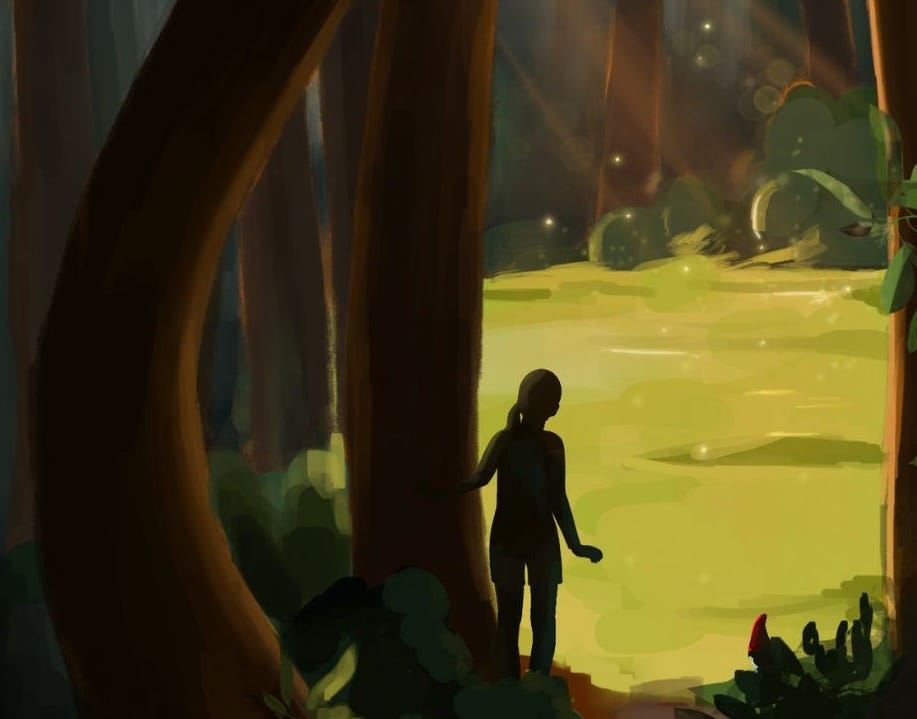
Preferring the retreat of her inner life over her outer one, Darcy also has no interest in her annoying neighbor, Samantha Palm, who persistently attempts to make friends with her. So when she finds herself dragged off to a week of summer camp with Sam and both their families, she resigns herself to misery. Little does she know her week at Cedar Cove Family Camp is about catapult her and Sam through a gateway to a magical world where she will not only discover her purpose but step into a series of events laid out for her long ago.
The Six is not just the first book in a long series, it’s also the first book I wrote with serious intent to publish. I had tried to get a previous book published, but I can’t call that effort serious; The Six was the first real book I approached with professionalism, planning it before I wrote it, finding inspiration in meaningful places, and writing it as an adult rather than a teenager or college student. I knew this book would set the tone for the remaining five books in The Gateway Chronicles, so I was keen to get it right while also being aware of my limitations as a young and inexperienced writer. So I set myself a real timeline to outline and draft it, and I prepared for writing the novel by doing research into how to do it.
In my efforts to get it right, I looked to the stories that made me.
How had the authors I admired done what I wanted to do? In what ways had they injected the same “magic” into their stories that I wanted to inject into mine? What kept me turning the pages, what gave me emotional thrills, where were the storybeats and the plot reveals, how was character development achieved? I studied chapter openings and endings, dialogue, how authors handled scenes with many characters vs scenes with just one or two and how scenes flowed from one to the next. I picked up books I loved that I wanted my books—starting with The Six—to move, feel, and sound like.
To write The Six, I studied the storytelling style and composition of, primarily, The Lion, the Witch and the Wardrobe, Harry Potter, and Pride and Prejudice.
Why these three books (and book series) in particular?
In studying The Lion, the Witch and the Wardrobe and the storytelling methods of C. S. Lewis, I hoped to learn how to tell a good story that was Christian while maintaining mainstream appeal.
I knew I was writing a similar story in style and function (portal fantasy, with a prophecy, with a God-figure), and the last thing I wanted was for The Gateway Chronicles to come out (or start out!) feeling like message-forward Christian propaganda. Especially because by the time I started my writing career, I felt that certain lines in publishing had been clearly drawn, and I didn’t want to end up on the side of the line that said art had to pay service to message. Lewis had avoided these things while writing pretty overtly Christian stories, and I set out to determine how he’d done so (finding, in the process, that form and function for a Christian storyteller should flow together as one to make something beautiful, but I’ll reserve those thoughts for another time…or maybe even a whole book that I may or may not be working on).
I determined to study the Harry Potter series before I wrote The Six because something I always loved about reading Harry Potter was that each book in the series encompassed a year of Harry’s life. I got to grow up with Harry, Ron, and Hermione, watching them mature, learning what they learned alongside them, and feeling the fulfillment of each installment in the series—the smaller mysteries—as they fed into the big story. The metanarrative of Harry Potter never gets set aside, rather each narrative that stands on its own also plays an important part to the whole, and the development of the characters is intrinsic to the revelations as they unfold as well.
I wanted to do the same with The Gateway Chronicles, so I spent a lot of time looking at how Rowling timed scenes, built reveals, placed Easter eggs, and matured her characters—not just the main trio, but also how she introduced side characters. From Rowling I learned the importance of not introducing pointless people, facts, or narrative details, and to build mysteries gradually and subtly so that when the payoff comes, it is satisfying.
I am well aware that Rowling is not a master of writing craft, per se, but she is absolutely one of storytelling. It’s from studying Harry Potter that I learned not only to read closely, but to write stories of my own that would stand up to being read closely.
It is also largely thanks to my study of Harry Potter that I turned to Pride and Prejudice while preparing to write The Six. I was not by any means new to Pride and Prejudice as it has been one of my favorite novels since I was thirteen years old—and one I have read many times—but when studying Harry Potter, I came across an interview with J. K. Rowling in which she said she learned to write her narrative turns at the end of her stories by studying how Jane Austen did it.
Austen was a true master of the turn at the end of a story—of misdirecting her readers into thinking one thing is happening, one person is the hero, and then revealing who has really been the hero all along. Her mastery of the narrative turn sends you reeling back into previous pages, wondering how you could have missed it! How did you not see it all along? When I read Rowling’s words on Austen, I thought “of course!” and went back for a deep dive myself, bolstering my love of Austen and my understanding of how to capture, misdirect, and then pull the rug out from under a reader—but all in such a way as to make them feel not as though they’ve been had, but that they have seen it all along just under the surface, of course they have, you just…surprised them!
The breathless “ah ha!” and the satisfying ending, and characters you can grow with and love, the story that feels eternal without preaching, and goodness baked in at the bones… These are all things I sought to learn from the stories I loved before I set out to write The Six.
I know I did them imperfectly, how could I not? I was young and it was my first serious novel. But I tried again and again (and I still try!), to do them myself, and I added more inspiration to my study of storytelling craft as the years went on.
I’d love to know what you think, so let me know in the comments! (And this is a Part 1 of a series of these I plan on doing. I’ll be back another time to talk about another of my books.)
Before I go…
What I’m loving at the moment:
-Wake Up Dead Man, the third of the Knives Out movies (written and directed by Rian Johnson). Available on Netflix right now, and it’s phenomenal! Appropriate for older teens and up. As many have pointed out in their own reviews and on social media, it’s the most Christian film (Christian in the Christic sense, not message-forward) I have seen in a long time.
-I just finished two books I thought were simply astonishing: Divine Rivals by Rebecca Ross and Small Things Like These by Claire Keegan. Divine Rivals is a New Adult semi-epistolary fantasy novel about a mythological war that is beautifully written and conceived. Everything about it is great if you’re looking for a new read. (older teens and adults.) Small Things Like These is a short read, highly acclaimed, about an ordinary man in Ireland in 1983 who suddenly wakes up to a great evil happening right under the fabric of society. It will take your breath away.
-The work I’m doing for Owl’s Nest Publishers. We continue to put wonderful books for adolescents out into the world, and we are right now offering all our books for sale on Kindle (just $.99 each/two of them are $1.99 each). The sale runs today through December 25!
-Gateway Chronicles official merchandise by Lexie Foster. If you need some last-minute stocking stuffers, check out the stickers, mugs, tote bags, shirts, and more in her Etsy shop.
Thank you, I loved hearing about the behind the scenes and I'm looking forward to the other posts in this series!
ok i knew about the inspiration taken from harry potter and narnia but i didn’t know about pride and prejudice!! how fun!! i guess i just have to read them again to look for that 😉